

If your reflux is worst at night, you have probably heard two pieces of advice: sleep on a wedge pillow, or raise the head of your bed. Both use the same idea — gravity keeping stomach acid where it belongs — but they feel very different in practice, cost very different amounts, and suit different sleepers. Here is how they actually compare, and which one is the better first step for you.
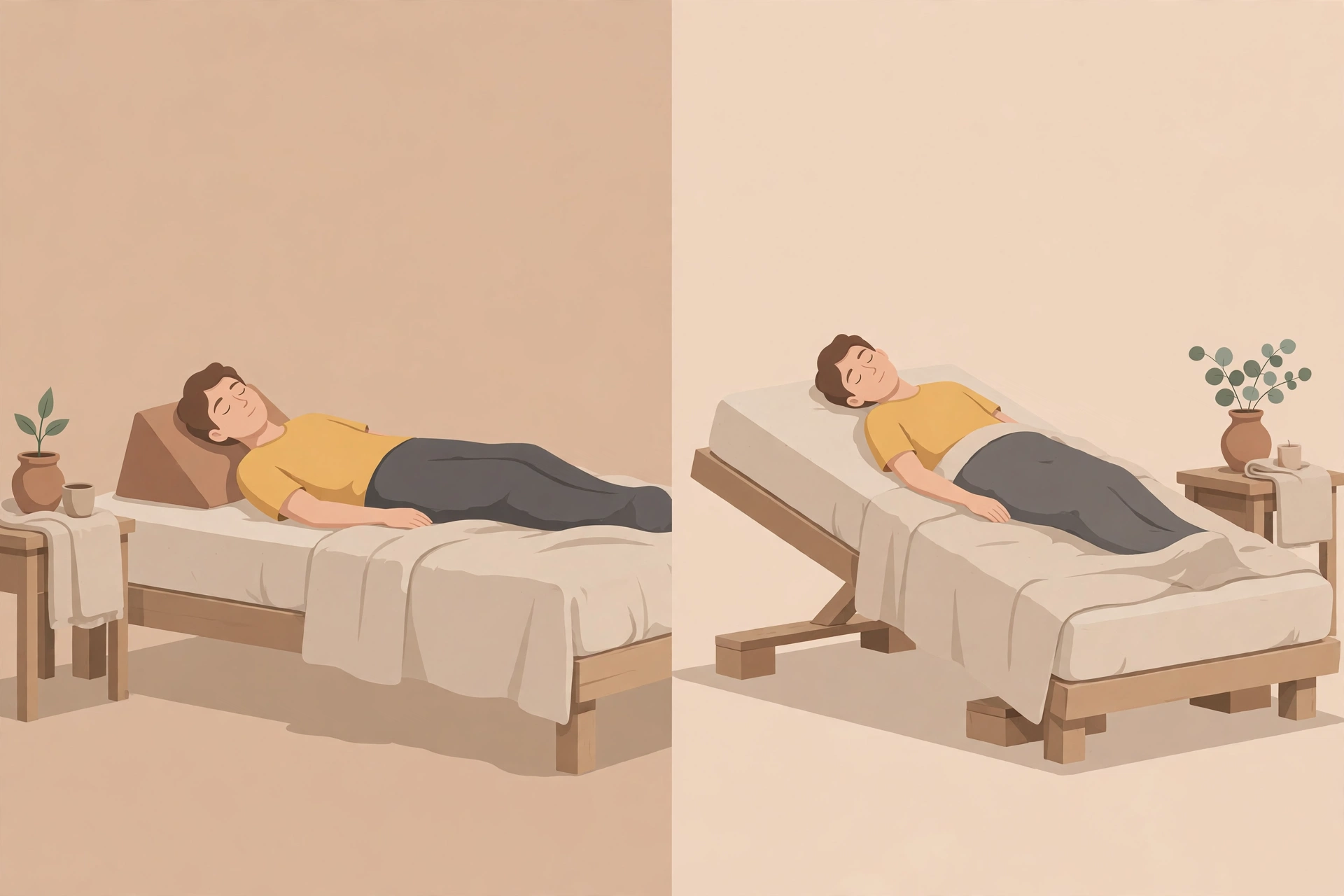
Wedge pillow vs raising the head of the bed — which works better for reflux?
For most people, raising the head of the bed works slightly better, because it lifts your whole upper body on a gentle, even slope and you cannot slide off it. A wedge pillow is the cheaper, faster and more flexible option, and it works well if you pick the right height and can stay on it. If you can only try one thing, raise the bed. If you want a low-commitment test first, start with a wedge.
our review of the Coop Adjustable Wedge Pillow — it explains how an adjustable wedge lets you find the height that suits you before committing to anything more permanent.
Why does raising your head help reflux at all?
When you lie flat, your oesophagus and your stomach sit at roughly the same level, so acid can flow back up easily. Lifting your head and chest by 15 to 25 centimetres (about 6 to 10 inches) puts gravity back on your side: acid has to travel uphill to reach your throat. The American College of Gastroenterology lists raising the head of the bed among the lifestyle measures for reflux, and as of November 2026 its guidance still points to roughly 6 to 10 inches of lift as the target range. That figure is the same whether the lift comes from a wedge or from the bed itself — what matters is the height and the angle, not the method.
This is general information, not medical advice. If your reflux is frequent, severe, or not responding to positioning changes, speak to your doctor rather than trying to solve it with bedding alone.
What a wedge pillow actually does
A wedge pillow is a firm, triangular foam pillow that sits on top of your mattress and raises your head, shoulders and upper chest on a slope. Most reflux wedges are 7 to 12 inches high at the tall end. The slope is steeper than a raised bed, which is both its strength and its weakness: the steeper angle can feel more effective against reflux, but it is also what makes some people slide down during the night or wake with a stiff neck.
Wedges have three practical advantages. They cost far less than bed risers or an adjustable base. You can take one when you travel or move it to the sofa. And you can test the whole idea for the price of one pillow, then stop using it if it does not suit you. Our guide to wedge pillow heights explains which height suits which sleeper.
The main drawback is staying put. Because only your upper body is raised and the rest of you is flat, gravity pulls you down the slope. Some people solve this with a body pillow wedged at their hips, or by choosing a longer, gentler wedge — but for restless sleepers it stays the biggest complaint. There is also the shoulder problem: side sleepers often find the edge of a wedge digs into their shoulder, which we covered in our side-sleeper guide.
What raising the head of the bed actually does
Raising the head of the bed means lifting the whole head end of the bed frame — usually with bed risers, blocks under the legs, or an adjustable base — so the mattress itself slopes gently from head to foot. The angle is shallower than a wedge, typically around 5 to 10 degrees, and your whole body rises together, so there is nothing to slide off and no edge pressing into your shoulder.
That even, whole-body slope is why it tends to work slightly better in practice. Studies of head-of-bed elevation generally test the bed-raised method rather than wedge pillows, so the evidence base is stronger for it too. The trade-offs are cost and commitment: bed risers are cheap, but a stable set that lifts 6 to 10 inches costs more than basic risers and can make the bed wobble; an adjustable base is the comfortable option and by far the most expensive one. It is also a change to the bed itself, so it affects a partner who shares it — although separate risers under one side, or a split adjustable base, can solve that.
Wedge pillow vs raised bed: side by side
| Wedge pillow | Raised head of bed | |
|---|---|---|
| Typical cost | One pillow, low cost | Risers: low; adjustable base: high |
| Slope | Steeper, 20–30 degrees | Gentler, about 5–10 degrees |
| Sliding | Common complaint | Not an issue |
| Side sleepers | Shoulder can catch on the edge | No edge to catch on |
| Partner | Only affects you | Affects both sides unless split |
| Portable | Yes, take it anywhere | No |
| Evidence base | Weaker, mostly extrapolated | Stronger, directly studied |
Which one should you try first? It depends
Start with a wedge pillow if: you want to test whether elevation helps before spending more; you sleep alone or your partner does not want the bed changed; you travel and want the same setup away from home; or you also want the pillow for reading and sitting up in bed.
Raise the head of the bed if: you already know elevation helps and want the most comfortable long-term version; you slide off wedges or wake with neck pain from them; you are a side sleeper whose shoulder catches on a wedge edge; or you share the bed and your partner is happy with the change.
Try both in sequence if: you are unsure. A wedge is the cheap experiment. If it helps but you keep sliding down, that is useful information — it tells you elevation works for you and a raised bed is worth the next step. If a wedge does nothing at all, raising the bed is unlikely to transform things either, and it is worth talking to your doctor about other options.
How to raise the head of your bed properly
If you go the bed route, a few practical points matter. Raise the head end only, by 6 to 10 inches — lifting the whole bed does nothing. Use solid, stable risers or blocks made for the job, not books or bricks, and check the bed is steady before sleeping on it. Do not just stack extra pillows: that bends your neck forward without lifting your chest, which can make reflux worse and leaves you with a sore neck. And give it at least a week — the first night on a slope feels odd, and most people need a few nights to judge whether it is helping.
Frequently asked questions
Can I use a wedge pillow and raise the bed at the same time? You can, but there is rarely a reason to. One source of elevation is usually enough, and combining them can push your neck into an uncomfortable bend. Pick one method and get the height right first.
Is raising the head of the bed better than a wedge pillow for severe reflux? As of November 2026, the guidance favours head-of-bed elevation, and the whole-body slope is easier to stay on all night, which matters more than the angle on paper. But “better” depends on the sleeper — a wedge that you actually use beats a raised bed you never get round to setting up.
How high should the head of the bed be for reflux? About 6 to 10 inches (15 to 25 centimetres) at the head end. Less than that may not create enough of a slope; much more than that tends to make you slide towards the foot of the bed.
Will a wedge pillow help if I am a stomach sleeper? Probably not. A wedge is designed for back and side sleepers, and lying face down on a slope is uncomfortable for most people. If you sleep on your stomach and have reflux, raising the head of the bed is usually the better option, or talk to your doctor about other approaches.
Sources: American College of Gastroenterology, “Acid Reflux / GERD” — https://gi.org/topics/acid-reflux/ — head-of-bed elevation as a lifestyle measure for reflux, 6–10 inch target range (“Use an under-mattress foam wedge to elevate the head about 6-10 inches”).