

You bought a wedge pillow to sleep inclined, and instead you wake up halfway down the bed, bunched at the bottom of the slope, with a sore neck and the same heartburn you were trying to escape. Sliding is the most common reason people abandon a wedge, and it is usually fixable — but only once you know which of the several causes is yours.
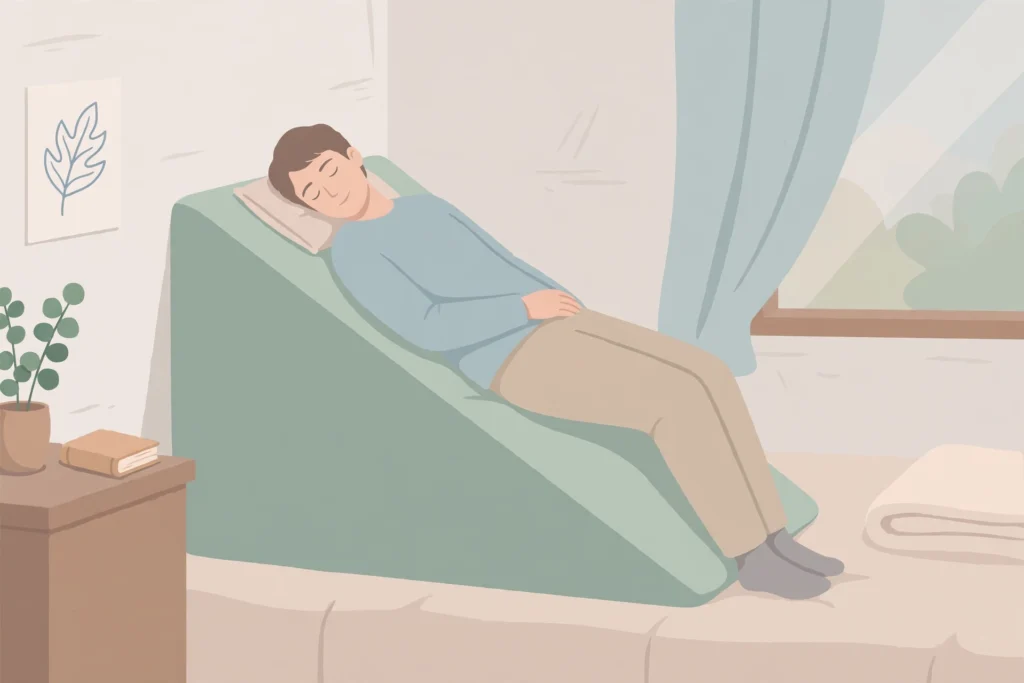
Why do I keep sliding down my wedge pillow at night?
You slide because gravity, which is supposed to be helping you, has nothing holding you in place: a slope that is too steep, too short, or too slippery lets your body drift downhill as your muscles relax in sleep. The fix is usually a combination of a gentler setup, more grip between wedge and mattress, and a longer wedge that supports your whole torso — not a new pillow bought in frustration.
If your wedge is steep and you slide every night, a gentler incline may suit you better — see our review of the Cozymaker 7.5-inch wedge, a lower, single-piece wedge many first-time users find easier to stay on: https://www.bestwedgepillows.com/cozymaker-7-5-inch-bed-wedge-pillow-review/
What a wedge pillow actually is
A wedge pillow is a triangular foam ramp that goes under your head, shoulders and upper back in place of, or under, a regular pillow. It holds your upper body on a steady slope all night, so your head stays higher than your stomach. That matters for reflux because gravity then works against acid travelling back up into the oesophagus, rather than letting it pool while you lie flat. Mayo Clinic’s guidance for heartburn at night, as of November 2026, is to raise the head of the bed 6 to 9 inches, or to use a wedge that elevates the entire upper body — and it stresses that raising just your head with extra pillows is usually not effective. This is general information, not medical advice.
Why sliding happens: the four usual causes
Sliding is rarely one fault. Check these four before changing anything else.
First, the slope is too steep for you. A 12-inch wedge gives gravity more to work with, and that includes pulling you downhill. Steeper wedges are the ones people slide down most, especially in the first two weeks. Second, the wedge is too short. If it ends around your shoulder blades, your hips sit on the flat mattress and your torso perches on the slope, so there is nothing to anchor you. A wedge that runs from your hips to your shoulders keeps your weight on the incline itself. Third, something is slippery: a smooth cover on a smooth mattress, a silky pillowcase, or a wedge with no non-slip base all reduce friction. Fourth, your pillow setup pushes you down. A thick pillow on top of a wedge can shove your head forward and your body downhill, and sleeping with your knees straight on a steep slope gives gravity a straight run.
| Cause | What it looks like | First fix to try |
|---|---|---|
| Slope too steep | You slide every night, worse on a 12-inch wedge | Try a gentler height, or a lower setting if your wedge adjusts |
| Wedge too short | Your hips sit off the wedge, shoulders near the top edge | Switch to a longer wedge that supports hips to shoulders |
| Slippery surfaces | Wedge itself creeps down the bed, or you slide on the cover | Non-slip mat or liner under the wedge; cotton cover |
| Pillow pushing you down | Thick pillow on top, neck bent forward | Thin pillow, or none, on top of the wedge |
The setup that stops most sliding
Work through these in order, one night at a time, so you know which change helped.
- Put the wedge flat on the mattress, pushed right up against the headboard or wall. A gap behind it invites the whole wedge to creep down the bed overnight.
- Add grip underneath. If your wedge has a non-slip base, make sure that side is down. If it does not, a cheap non-slip shelf liner or rug-grip mat between wedge and mattress, cut to size, usually stops the wedge itself moving. The same trick under your fitted sheet can help if the sheet slides.
- Use a thin pillow on top, or none at all. Your head should rest on the slope with your neck in line with your spine, not jacked forward. Many people find the wedge alone, with a thin pillow, gives a cleaner slope and less neck strain than a thick pillow.
- Bend your knees slightly, or put a small pillow under your knees. Bent knees break up the straight downhill line and take pressure off your lower back, which also helps you stay put.
- Wear or use cotton, not satin, on the wedge. A cotton pillowcase and a cotton cover give more friction than silky fabrics, and they breathe better through the night.
- Give it a full week or two. Sleeping on an incline feels odd at first, and the first few nights are the worst for sliding. Judging a wedge after one night usually says more about the change than the pillow.
It depends: which fix fits your situation
Sliding does not have one universal answer, because the right fix depends on your height, your sleep position and your wedge.
If you are a back sleeper on a steep wedge, the gentler-height and bent-knees fixes usually do the most. Back sleepers slide in a straight line, so grip underneath and a longer wedge matter more than anything fancy. If you are a side sleeper, a wider wedge helps more than a steeper one: a narrow wedge leaves your shoulder hanging off the edge, and you roll downhill to compensate. Our heights guide compares 7.5, 10 and 12-inch wedges and the trade-off between gentleness and elevation: https://www.bestwedgepillows.com/wedge-pillow-heights-explained-7-5-vs-10-vs-12-inches-for-reflux/
If you are tall or heavier, a short wedge is the likeliest culprit — you need length, not just height, so your torso is fully supported. If you share the bed, a full-length or bed wedge that lifts the whole mattress can stop the “one side slides, the other does not” problem, though it is a bigger purchase. And if you use the wedge for reading or resting upright as well as sleeping, remember that sitting bolt upright and then lying back changes where you sit on the slope; reset your position each time you lie down for the night rather than sliding into sleep from a sitting position.
When sliding means you have the wrong wedge
Some sliding is a setup problem. Persistent sliding after two weeks of the fixes above is a wedge problem, and it is worth saying so plainly rather than enduring it. Consider a different wedge if: the slope is so steep you cannot stay on it even with grip and bent knees; the wedge is so short your hips never reach it; or you wake with neck or back pain that started with the wedge and has not eased. In that case a gentler, longer, or adjustable wedge is the honest next step — an adjustable wedge lets you try a lower incline without buying twice. Do not keep a wedge that hurts you out of stubbornness; a wedge you cannot sleep on helps no one, whatever its height.
This is general information, not medical advice. If sliding comes with new or worsening back or neck pain, numbness, or reflux that does not improve with positioning and lifestyle changes, talk to a clinician rather than relying on a pillow alone.
Frequently asked questions
Will a non-slip mat really stop me sliding down a wedge pillow?
Often, yes — but only for the part of the problem where the wedge itself creeps down the bed. A mat under the wedge stops the wedge moving; it does not stop your body sliding on a too-steep or too-short slope. Use it alongside the other fixes, not instead of them.
Should I put my wedge under the mattress instead?
Some bed wedges are designed to go under the mattress and lift the whole bed, which removes the sliding problem entirely because you sleep on a flat, inclined surface. A standard pillow wedge is not designed for that, and putting one under a heavy mattress usually just flattens it. Check what your wedge is made for before trying this.
How long does it take to stop sliding?
Most people see a big improvement within a week of fixing the setup, and the adjustment period for sleeping on an incline is usually one to two weeks, as of November 2026. If you are still sliding every night after two weeks with grip, bent knees and a thin top pillow, the wedge itself is probably the wrong height or length for you.
Does a higher wedge always make sliding worse?
Not always, but steeper usually means more sliding, especially at 12 inches. The trade-off is real: a higher wedge gives gravity more help with reflux, and more pull downhill. That is why matching height to symptom severity matters — the gentlest height that controls your symptoms is also the easiest to stay on.
The bottom line
Sliding down a wedge pillow is usually a setup problem with a cheap fix: wedge flat against the headboard, grip underneath, a thin pillow on top, knees slightly bent, and a week or two to adjust. If those fixes do not work, the wedge is probably too steep or too short for you, and a gentler, longer wedge is a better answer than another night of sliding. For more on wedge types, see our main guide to wedge pillows for acid reflux, GERD and heartburn at https://www.bestwedgepillows.com/
Sources: Mayo Clinic guidance on managing heartburn without medication (https://www.mayoclinic.org/connected-care/7-ways-to-manage-heartburn-without-medication/cpt-20515431). This is general information, not medical advice.