
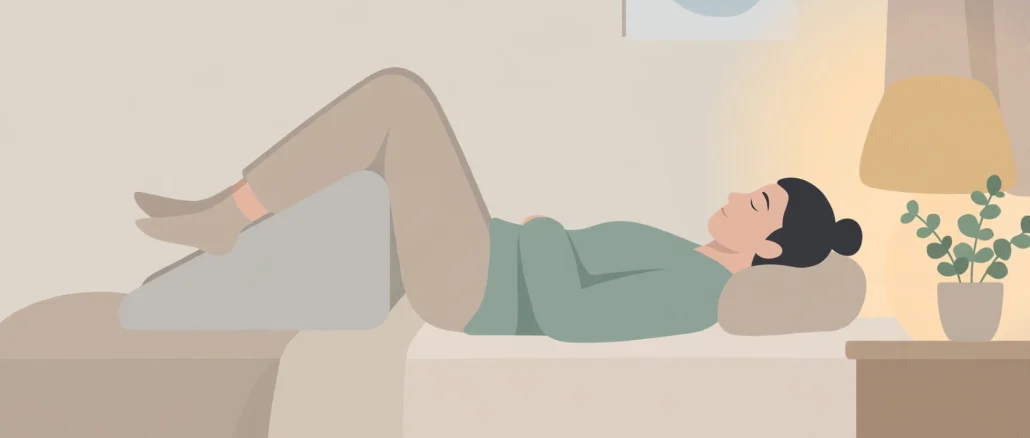
If your lower back aches most in the morning, the way your legs rest overnight may be part of the problem. Lying flat on your back with your legs straight can pull on the muscles at the front of your hips, which in turn arches your lower back and loads the small joints and discs there. Bending your knees slightly takes that pull away. A leg wedge pillow is simply a shaped way of holding that bent-knee position all night, where loose pillows slip and slide. It helps some people a great deal and does nothing for others — and the difference comes down to why your back hurts and how you sleep.
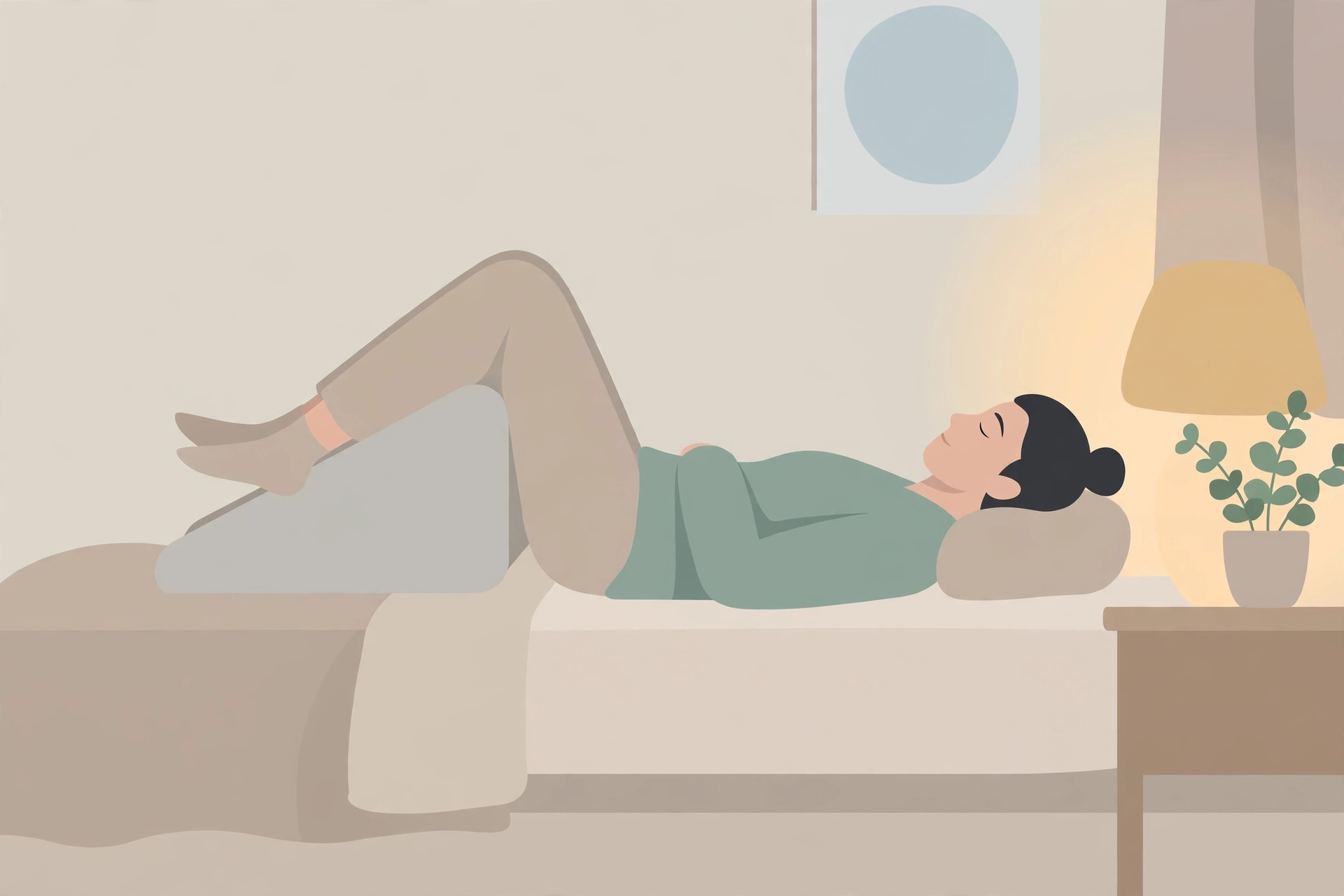
Does elevating your legs help your back?
Yes, for many people it does — a little, and only in the right position. Raising your knees slightly while you lie on your back relaxes the hip flexor muscles, lets your pelvis tilt back a fraction, and lets your lower back settle flatter against the mattress instead of arching. That takes pressure off the discs and the small facet joints. Mayo Clinic gives the same advice in plain terms: back sleepers should place a pillow under their knees, because it “may help relax your back muscles and maintain the curve of your lower back” (Mayo Clinic, “Sleeping positions that reduce back pain”, as of November 2026). It is a comfort measure, not a treatment — it changes how you rest, not what is causing the pain.
If you want to try it, the cheapest test costs nothing: fold a pillow under your knees tonight. If you wake up easier, a shaped wedge is worth considering — our Kehangte leg elevation pillow review shows what a four-height adjustable wedge looks like in practice.
How does a leg wedge actually help a sore back?
Three things happen when your knees bend a little while you lie on your back. First, the psoas muscle — the deep hip flexor that runs from your spine to your thigh — shortens and relaxes. When it is tight, it pulls the front of your pelvis down and exaggerates the arch in your lower back. Second, with the pelvis tilted back slightly, the lower back flattens gently against the mattress, which spreads the load more evenly across the discs instead of concentrating it. Third, the position takes the hamstrings out of the stretch they are under when your legs lie flat, which is another source of overnight stiffness for many people.
A leg wedge holds that knee bend steadily. A stack of ordinary pillows can do the same job for a night, but pillows compress, slide apart and end up on the floor by 3 a.m. — a wedge keeps the angle where you put it. That is the whole advantage: consistency, not magic.
Who is it most likely to help?
- Back sleepers with a dull morning ache. If your back feels stiff when you wake and eases once you are moving, overnight positioning is a likely contributor, and a wedge under the knees is a sensible first thing to try.
- People whose pain is worse lying flat. If lying on your back with straight legs is the position that bothers you most, the knee-bend mechanism is directly relevant.
- People with mild sciatica-type symptoms. Elevating the legs can take a little pressure off the nerve roots in the lower spine, and some people find the radiating ache eases. This is not a treatment for sciatica — if the pain shoots down your leg, is getting worse, or comes with numbness, that needs a clinician, not a pillow.
- Anyone recovering from knee or hip surgery who must keep the leg raised. The same wedge does double duty: elevation for swelling and a kinder position for the back. (our guide to leg elevation after knee surgery)
Who should skip it — or use it differently?
- Side sleepers. A wedge under your knees does nothing for you on your side. What helps side sleepers is a pillow between the knees, which keeps the hips stacked and stops the top leg pulling the spine out of line. Mayo Clinic recommends exactly that, and a leg wedge is the wrong tool for the job — a knee pillow or a body pillow fits better. (Our comparison of wedge pillows and body pillows)
- Stomach sleepers. Lying face down with your legs raised arches the lower back further, which is the opposite of what you want. Mayo Clinic’s advice for stomach sleepers is to try another position if possible, and if you cannot, to put a pillow under the hips and lower stomach instead.
- People with circulation problems or who have been told to keep their legs flat. Elevation changes blood flow. If a doctor has given you specific instructions about leg position — after vascular surgery, for example — follow those, not a pillow guide.
- Anyone whose back pain comes with red-flag symptoms. Pain with leg weakness, numbness in the saddle area, bladder or bowel changes, fever, or pain after a fall needs medical assessment promptly. A wedge will not fix those and could delay care if it masks the urgency.
How high should the wedge be?
Not very. The aim is a gentle knee bend — roughly 20 to 30 degrees at the knee — not a steep ramp. In practice that means the thick end of the wedge sits under the back of your knees and the lower legs rest on the slope, with your heels a few inches above the mattress. Most leg wedges are 7 to 10 inches tall at the high end, and that is plenty; an adjustable wedge lets you start low and add height until the position feels right.
Too much height causes its own problem: if your knees are bent too far, your lower back can flatten too much and lose its natural curve, and your calves can start to ache from the pressure. If you wake with sore calves or a feeling of pressure behind the knees, lower the wedge.
| Sleep position | Where the support goes | Best tool | What Mayo Clinic says (as of November 2026) |
|---|---|---|---|
| On your back | Under the knees, knees slightly bent | Leg wedge pillow | “May help relax your back muscles and maintain the curve of your lower back” |
| On your side | Between the knees | Knee pillow or body pillow | Helps align the spine, pelvis and hips |
| On your stomach | Under the hips and lower stomach | Flat pillow | “Can be hard on your back” — try another position if you can |
| Sitting up in bed | Behind the back | Upper-body wedge pillow | Recline instead of slumping |
How do I set it up tonight?
- Lie on your back and slide the wedge across the bed so the thick end sits just behind your knees.
- Let your lower legs rest on the slope, heels a few inches off the mattress. Your knees should feel slightly bent, not propped up high.
- Check your head pillow: it should keep your neck in line with your chest and back, not push your chin toward your chest.
- Give it three or four nights. One night is not a fair test — your body needs a few nights to settle into a new position, and back pain varies from night to night anyway.
- If your back feels better but your calves ache, try a lower height. If nothing changes after a week, the wedge is probably not the answer for your particular pain, and your money is better spent elsewhere.
Is a leg wedge better than a stack of pillows?
For one night, no. For every night, yes — if you decide the position helps. Pillows are free and you already own them, so they are the right way to test the idea. A wedge earns its place only after the test works: it holds one angle all night, it does not need rebuilding at bedtime, and it frees your pillows for your head. Our leg wedge reviews cover the adjustable options worth looking at once you know the position suits you — start with the leg wedge pillar page.
When should I see a doctor instead?
Most lower back pain improves within a few weeks, and positioning is one of the low-risk things you can try in the meantime. See a clinician promptly if the pain is severe or getting worse, if it follows an injury, if it comes with numbness, weakness or tingling in a leg, if you have bladder or bowel changes, unexplained weight loss, or a fever, or if it has not improved after a few weeks of sensible self-care. This article is general information, not medical advice — it cannot diagnose your back, and nothing here replaces an assessment of your own situation.
FAQ
Does sleeping with my legs elevated really help back pain?
For many back sleepers, yes — a slight knee bend relaxes the hip flexors and lets the lower back settle flatter, which takes pressure off the discs and joints. Mayo Clinic lists a pillow under the knees as a recommended position for back sleepers (as of November 2026). It helps some causes of back pain and not others, so treat it as a low-cost experiment, not a cure.
How high should I elevate my legs for back pain?
Aim for a gentle bend of about 20 to 30 degrees at the knee — heels a few inches above the mattress. Most leg wedges of 7 to 10 inches at the high end give you that. Higher is not better: too much height can flatten the lower back too far and make your calves ache.
Can a leg wedge make back pain worse?
It can, if the height is wrong or the position is wrong. Stomach sleepers should not use one under their knees, side sleepers need a pillow between the knees instead, and anyone who wakes with sore calves or new pain should lower the wedge or stop using it.
Should I buy a leg wedge or just use pillows?
Use pillows first — they cost nothing and tell you whether the position helps. If it does, and you are tired of rebuilding the stack every night, a wedge is the durable version of the same idea. Adjustable wedges are the safest buy because you can change the height until it suits you.
Sources
- Mayo Clinic, “Sleeping positions that reduce back pain” — https://www.mayoclinic.org/diseases-conditions/back-pain/in-depth/sleeping-positions/art-20546852 (accessed November 2026)
- Best Wedge Pillows, “Leg Elevation After Knee Surgery: How High, How Long” — https://www.bestwedgepillows.com/leg-elevation-after-knee-surgery-how-high-how-long/
- Best Wedge Pillows, “Wedge Pillow vs Body Pillow: Which Solves Your Problem?” — https://www.bestwedgepillows.com/wedge-pillow-vs-body-pillow/