

You bought a wedge pillow to fix your reflux, and the reflux is better — but now you wake up with a stiff neck, an aching lower back, or a shoulder that complains every morning. It is a common trade-off. In most cases the pain comes from the setup, not the wedge itself: the wrong height, the wrong angle for your sleep position, or a shoulder with nowhere to go. The fix is usually a small adjustment, not a different product.
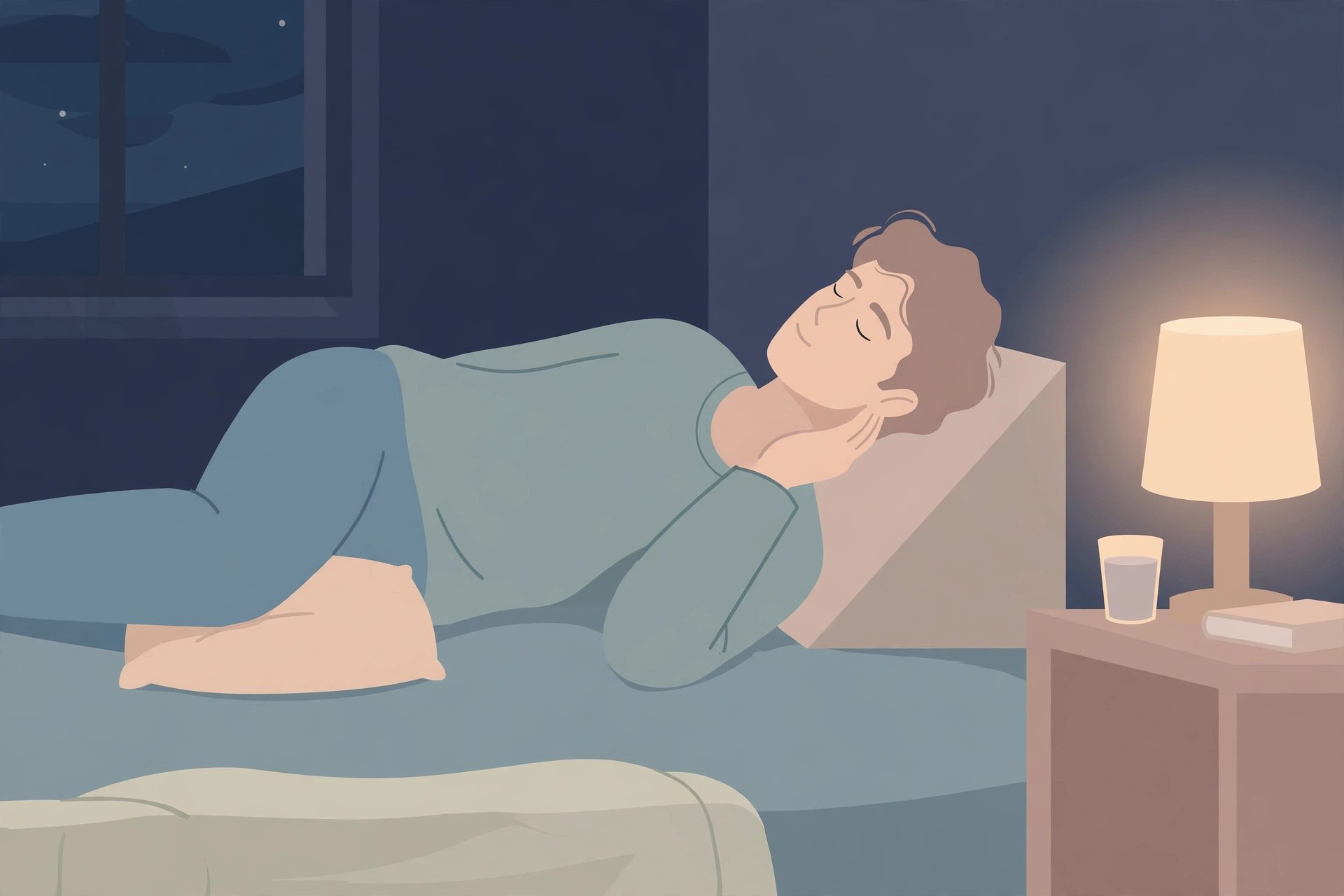
Can a wedge pillow cause back, neck or shoulder pain?
Yes — a wedge pillow can cause back, neck or shoulder pain when the height or angle is wrong for your body and sleep position. Too steep bends the neck forward; too low leaves the head unsupported; side sleepers often find the slope presses on the shoulder. It is usually a setup problem, and it can be fixed.
If your wedge only comes in one fixed height, an adjustable one makes the fix far easier — our review of the Coop Adjustable Wedge Pillow covers a wedge whose height you can change until the incline suits you.
Why does a wedge pillow hurt your back?
A wedge pillow lifts your upper body, and that changes the shape your spine holds all night. On a steep wedge, back sleepers often find their pelvis tilts and their lower back arches — the same posture that aches after a long drive. The muscles along the spine work to hold that curve for hours, and they complain in the morning.
Sliding down makes it worse. As you slip, your hips end up lower than your shoulders and your spine curves further, so you wake up sore even though the wedge felt fine when you first lay down. If sliding is part of your problem, our guide on how to stop sliding down a wedge pillow covers the fixes.
The simplest back-pain fix is also the oldest one: put a pillow under your knees. The Mayo Clinic’s guidance on sleeping positions that reduce back pain recommends exactly this for back sleepers — a pillow under the knees helps relax the back muscles and maintain the natural curve of the lower back. It works on a wedge too, and it costs nothing to try.
Why does a wedge pillow hurt your neck?
Neck pain on a wedge is almost always a height problem. The rule is simple, and the Mayo Clinic states it plainly: your pillow should keep your neck in alignment with your chest and back. A wedge that is too high for you pushes your chin toward your chest and holds the neck bent forward all night. A wedge that is too low lets your head tip backwards, leaving the neck unsupported. Either way, the neck muscles spend the night holding a position they were not built to hold.
The edge of the wedge matters as well. If the thick end sits under your shoulders instead of under your head, it can push the shoulders up and leave the neck hanging in the gap. The wedge should support your head and shoulders together, with the slope carrying you from the mid-back up.
Why does a wedge pillow hurt your shoulder?
Shoulder pain is mostly a side-sleeper problem. When you lie on your side on a wedge, your shoulder is caught between your body weight and the slope. If the wedge is too low, your head drops toward the mattress and your neck bends sideways for hours. If it is too high, the shoulder gets squeezed. The test is the same as with an ordinary pillow: when you are relaxed on your side, your nose should stay roughly in line with your breastbone, and your head should sit level — not tilted up or down.
Broad shoulders need more height than narrow ones, because the pillow has to fill the gap between your ear and the mattress after the shoulder has settled into the bed. That is why a wedge that suits your partner can hurt you, and why the right height depends on your body, not on the product’s marketing. Our guide for side sleepers with reflux covers the shoulder problem, including how to fill the gap.
How to tell if the wedge is the problem
Pain that appears only after you start using the wedge, and fades when you sleep without it for a few nights, points at the setup. Use the pattern to find the cause:
| Symptom | Likely cause | First fix to try |
|---|---|---|
| Lower back aches in the morning | Incline too steep; pelvis tilting | Lower the height; put a pillow under your knees |
| Neck stiff, chin tucked toward chest | Wedge too high for back sleeping | Lower the height |
| Neck sore, head tipping backwards | Wedge too low; head unsupported | Raise the height slightly, or add a small rolled towel under the neck |
| Shoulder aches (side sleepers) | Shoulder compressed; head not level | Fill the gap between ear and mattress; try a wider wedge |
| Sliding down overnight | Incline too steep or cover too smooth | Lower the height; add a non-slip layer |
Change one thing at a time and give each change three or four nights. Changing height, position and pillows all at once tells you nothing about which change helped.
How to fix wedge pillow pain
Start low and work up. Most people who hurt on a wedge started on one that was too steep — often a 12-inch wedge chosen for severe reflux. A 7.5-inch or 10-inch incline still lifts the upper body enough to help reflux for many people, and it is far kinder to the neck and back. Our wedge pillow heights guide compares 7.5, 10 and 12 inches so you can match the height to your problem.
Then check the basics: a pillow under the knees if you sleep on your back, a pillow between the knees if you sleep on your side, and the wedge positioned so it supports head and shoulders together. Give the new setup at least a week — the first two or three nights on any new sleep position feel strange, and that is not the same as pain.
If the pain keeps coming back at every height, the wedge may simply not suit your body. An adjustable wedge, a lower incline, or raising the head of the bed with risers instead are all reasonable next steps — and a wedge is not the only way to get elevation.
It depends: who should skip a wedge pillow, and who it suits
There is no single verdict, because the right answer depends on how you sleep and what your body tolerates. Back sleepers with reflux are the best fit: the incline helps the reflux, and a pillow under the knees keeps the lower back happy. Side sleepers can do well too, as long as the height fills the shoulder-to-ear gap — our side-sleeper guide walks through that setup.
Be more cautious if you have an existing neck or spine problem, recent spinal surgery, or pain that shoots down an arm. In those cases, check with your doctor or physiotherapist before committing to a steep incline, and start with the lowest height. Stomach sleepers should usually skip a wedge altogether — lying face down on an incline twists the neck for hours, and no height adjustment fixes that.
When to see a doctor
Most wedge-related aches are setup problems that fade within a week or two of fixing the height. See a doctor promptly, rather than buying another pillow, if the pain comes with numbness or tingling down an arm, weakness in an arm or hand, loss of bladder or bowel control, or pain that keeps getting worse. The same applies to back or neck pain that lasts more than a few weeks despite changing the setup.
This is general information, not medical advice. It cannot diagnose the cause of your pain. If your symptoms are persistent, severe, or new, speak to a doctor.
See all our wedge guides on the homepage.
Sources: Mayo Clinic, “Sleeping positions that reduce back pain” (Mayo Clinic Health Information Library) — https://www.amerikanhastanesi.org/mayo-clinic-care-network/mayo-clinic-health-information-library/first-aid/sleeping-positions-that-reduce-back-pain — checked as of November 2026.
FAQ
Can a wedge pillow cause neck pain?
Yes — usually because the height is wrong for you. Too high pushes the chin toward the chest and holds the neck bent forward; too low leaves the head tipped back and unsupported. Lowering or raising the height by a step or two often fixes it within a few nights.
How long does it take to get used to a wedge pillow?
A few nights to about a week is normal. Mild strangeness in the first two or three nights is not the same as pain — but sharp or worsening pain is a sign to change the height, not to push through it.
Is a wedge pillow bad for your back?
Not in itself. A wedge that is too steep can arch the lower back and cause morning aches, but a moderate incline with a pillow under the knees suits many back sleepers. The Mayo Clinic recommends a pillow under the knees for back sleepers to maintain the lower back’s natural curve.
What height wedge pillow is best to avoid pain?
Start at 7.5 to 10 inches and only go higher if your reflux needs it. Our heights guide compares 7.5, 10 and 12 inches and explains which height fits which problem.