

Reading in bed should be relaxing, but the usual setup — a stack of pillows that flattens by chapter two, or sitting bolt upright against a hard headboard — leaves most readers with a stiff neck, an aching lower back, or both. A wedge pillow solves the geometry problem: one firm, angled surface lifts your whole upper body instead of just your head, so your spine stays in a gentle, supported curve. Used well, a wedge turns bed into a genuinely comfortable reading chair. Used badly — too steep, too soft, no lumbar support — it trades one ache for another. This guide covers the setup that works: the right height and angle, the lumbar trick that stops sliding, and when a wedge is the wrong tool for the job.
Is a wedge pillow good for reading in bed?
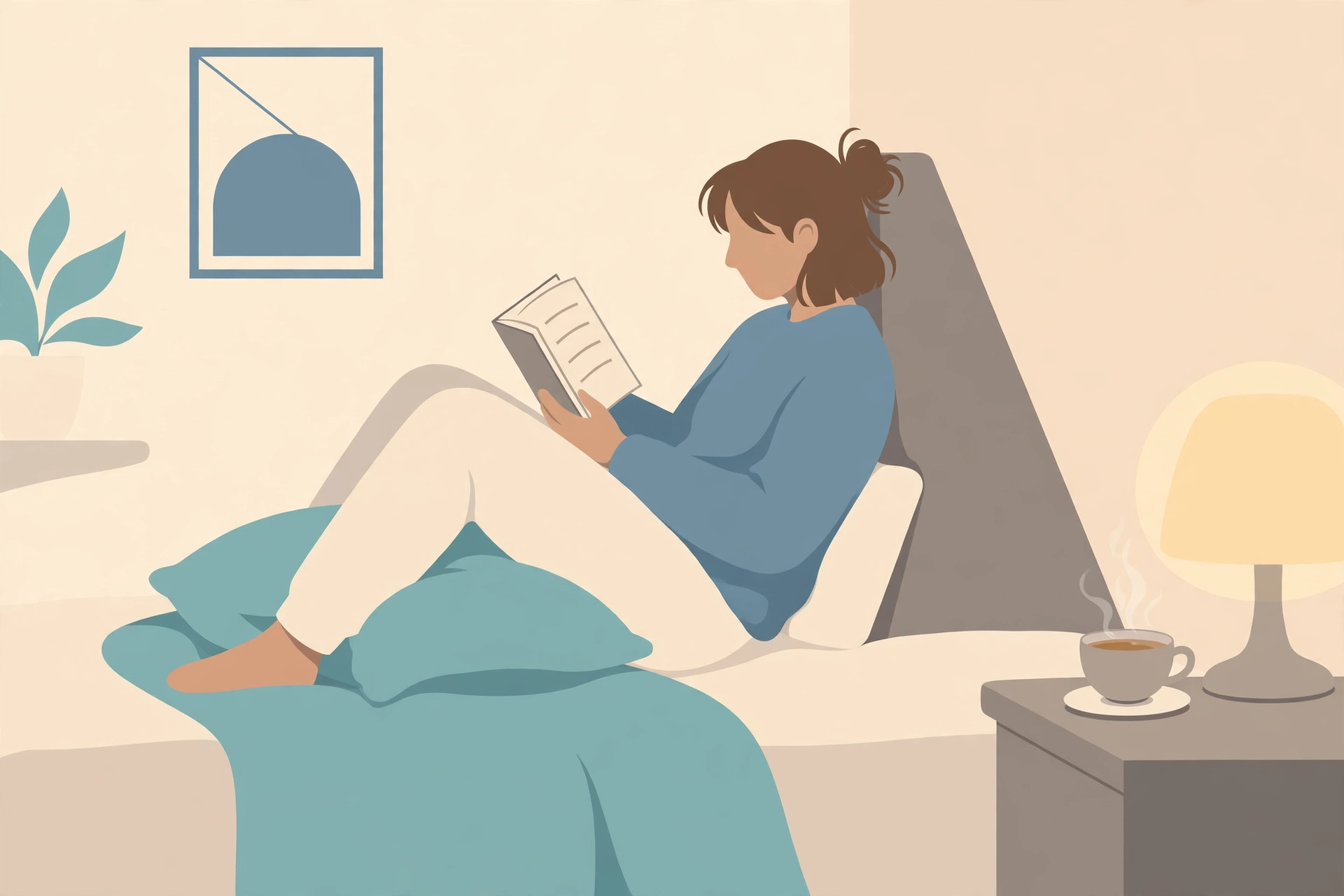
A wedge pillow is good for reading in bed when it is firm enough to hold its angle, between 7 and 10 inches high at the tall end, and paired with a small lumbar cushion at the base of your spine. That combination keeps your head, neck and upper back in one supported line, so you can hold a book or tablet at eye level without hunching. A soft wedge that flattens under your weight, or a wedge taller than about 12 inches, usually makes reading less comfortable, not more.
Our pick for a reading wedge: the Xtreme Comforts 7-Inch Memory Foam Bed Wedge Pillow
Check the current price on Amazon
As an Amazon Associate I earn from qualifying purchases.
Why the pillow stack fails (and what a wedge fixes)
A stack of ordinary pillows fails in three predictable ways. First, it compresses: soft pillows flatten under your shoulders within an hour, so the angle that felt right at page one is gone by page fifty. Second, it bends only your neck: pillows lift your head while your upper back stays flat, which is the classic recipe for a stiff neck. Third, it slides: every time you shift, the stack needs rebuilding.
A wedge fixes the geometry because it is one continuous slope. Your whole upper body — head, neck, shoulders and upper back — rises together at a single angle, so your spine keeps its natural curve instead of bending at one point. Elevating the head and upper body is also the standard positioning advice for nighttime reflux — the American College of Gastroenterology lists head-of-bed elevation among its reflux guidance (ACG, Acid Reflux / GERD). The foam matters here: a high-density or memory-foam wedge holds its shape under your weight, while a cheap, soft wedge behaves like a fancy pillow stack.
What height and angle work best for reading?
For reading, the sweet spot is a 7- to 10-inch wedge with an incline of roughly 25–30 degrees — noticeably gentler than the steeper wedges sold for severe reflux. That range lifts your head enough to read at eye level without forcing your chin down toward your chest.
7 inches: the best starting point for most readers, and the easiest to pair with a regular pillow on top for fine-tuning.
10 inches: better if you are tall, have a long torso, or like to read almost upright; check that your neck stays relaxed, not pushed forward.
12 inches and above: usually too steep for comfortable reading — fine for short sessions, but most people find it strains the neck after 20–30 minutes.
Your height matters more than any chart. A shorter reader on a 10-inch wedge sits more upright than a taller reader on the same wedge. If you can, test the angle with your usual book or tablet in hand: your eyes should meet the page with your head level, not tilted down.
The lumbar trick that stops sliding and backache
The most common complaint about reading on a wedge is sliding down the slope — and the fix is not a steeper wedge, it is lumbar support. Place a small, firm cushion (a rolled towel works too) in the curve of your lower back, right where the wedge meets the mattress. That single addition does two things: it fills the gap that otherwise lets your pelvis slide forward, and it supports the natural inward curve of your lumbar spine, which is what actually aches after an hour of reading.
Three more setup details that make the difference:
- Bend your knees slightly — a pillow under your knees takes pressure off your lower back and stops you sliding.
- Bring the book to your eyes, not your eyes to the book — a tablet stand or a book rest on your lap beats hunching forward.
- Keep your arms supported — rest your elbows on pillows at your sides so your shoulders stay relaxed.
Wedge pillow vs reading pillow (the one with arms)
The armchair-style reading pillow — the kind with back support and armrests — is the wedge’s main rival, and each wins in a different situation. The table below compares them honestly.
| Feature | Wedge pillow | Reading pillow (with arms) |
|---|---|---|
| Back support | Full-length slope, supports whole upper body | Supports the back only; lower back often unsupported |
| Arm support | None — needs side pillows | Built-in armrests |
| Versatility | Also works for reflux, snoring, leg elevation | Reading and sitting up only |
| Bed space needed | One wedge, 24–27 in wide | Wider footprint, plus armrests |
| Best for | Readers who also want reflux or snoring help | Readers who want arm support and sit fully upright |
When a wedge pillow is NOT the right reading setup
It depends on your body and your habits. Skip the wedge — or use it only for short sessions — if you have a lower-back condition that flares when you sit semi-reclined, if you read lying flat on your side (a wedge is a back-reader’s tool), or if you share a narrow bed and the wedge steals your partner’s space. People who read for hours at a stretch may be better off in a proper chair with a footrest than in any bed setup. And if reading in bed regularly leaves you with numb hands, tingling arms or pain that lasts into the next day, that is a sign to talk to a clinician rather than buy a different pillow. This is general information, not medical advice.
How to set up your reading wedge tonight
- Place the wedge against the headboard, tall end up, so the slope faces the foot of the bed.
- Add a small lumbar cushion at the base of the slope.
- Put a pillow under your knees.
- Add one regular pillow on top of the wedge if you want a softer surface for your head — but keep it thin, so it does not push your chin down.
- Set a timer for the first few nights: if your neck or lower back aches after 30–40 minutes, the angle is wrong for you, not the idea. Try a lower wedge or a different lumbar cushion before giving up.
Frequently asked questions
Can I use a wedge pillow for reading every night? Yes — most people can, as long as the height suits them and they use lumbar support. If you wake up stiff, try a lower wedge or a thinner top pillow first.
Is a 7-inch or 10-inch wedge better for reading? For most readers, 7 inches is the safer starting point; it is easier to adjust with a top pillow. Choose 10 inches if you are tall or prefer sitting almost upright.
Can I use my reflux wedge for reading? Yes. The same wedge works for both jobs — that is one of its advantages. A 7- to 10-inch wedge covers both reading and mild reflux; a 12-inch wedge is better for reflux than for reading.
Does reading on a wedge help neck pain? It can, when the wedge keeps your head and upper back in one supported line. It can also make neck pain worse if the wedge is too steep or too soft, so adjust the angle before blaming the wedge.
See all our wedge guides on the homepage.
This is general information, not medical advice. If you have a spine, neck or sleep condition, check with your clinician before changing your sleep or reading setup.
Sources: American College of Gastroenterology, “Acid Reflux / GERD” (https://gi.org/topics/acid-reflux/), as of November 2026 — head-of-bed elevation guidance; manufacturer specifications for the featured wedge.